Our Nation
Understanding Splinter Groups
Why a faction that breaks away from a recognized tribe cannot simply declare itself the tribe, and why that distinction matters for the Hassanamisco Nipmuc people.
The Basics
What Is a Splinter Group?
A splinter group is what forms when a faction breaks away from an established, recognized tribe, but never independently functioned as its own autonomous tribe throughout history. Breaking away doesn't erase the tribe it broke away from, and it doesn't create a new one. It creates a faction with a name and, often, a claim, nothing more.
This is exactly how the Bureau of Indian Affairs defines it. Under the federal regulations governing tribal acknowledgment (25 CFR Part 83), a splinter group, political faction, or entity that separates from a currently recognized tribe cannot be acknowledged as a tribe in its own right unless it can clearly demonstrate it functioned as a politically autonomous community throughout history, independent of the tribe it split from. The National Congress of American Indians operates the same way in practice: it recognizes one governing body per tribal nation, seated by that nation's own governmental process, not competing factions each claiming the same seat.
Imagine a sitting Vice President decides he no longer wants to be part of the federal government, declares the United States dissolved, and creates a new country in its place, insisting it's simply the legitimate continuation of the old one, deserving the same treaties and the same seat at the table. Nothing about that changes reality. A splinter group works the same way: declaring the original tribe dissolved and standing up a new organization in its place doesn't make the new organization the tribe.
Standing
Our Official Standing
This isn't a matter of opinion. It's written into the Commonwealth's own executive order.
In 1976, Governor Michael S. Dukakis signed Executive Order No. 126, naming the Hassanamisco Nipmuc Tribal Council, a governing body rather than an individual, as the Commonwealth's recognized point of contact for matters affecting the Nipmuc Tribe. The Nipmuc Nation Tribal Council is that governing council for the Hassanamisco Nipmuc people. That order has never been rescinded or replaced. Read the full order on our Government page.
The Massachusetts Commission on Indian Affairs exists under Massachusetts General Laws, Chapter 6A, Section 8A. That statute spells out exactly what the Commission is empowered to do: investigate problems common to American Indian residents, assist tribal councils and individuals in their dealings with state and local government agencies, and make recommendations to the Director of Housing and Community Development. Nowhere in that statute is the Commission given the power to acknowledge, recognize, or determine which entity is a tribe's legitimate governing body. That authority was never granted to it, which means it isn't the Commission's to use, no matter who signs the letter.
Sequence of Events
A Departure, Not a Dispute
Cheryll Holley abandoned her position within the Nipmuc Nation Tribal Council and unilaterally created a separate group, outside the Council's constitution, without its authorization, and without the process that constitution requires for any change in leadership.
Having left the governing body named in the 1976 Executive Order, she then established a new, separately named organization, the "Hassanamisco Nipmuc Band." You cannot abandon a governing body and then claim to still speak for it. Leaving the Council didn't transfer the Council's authority to the group formed afterward. It forfeited any claim to that authority. Read our full account of this on the News page.
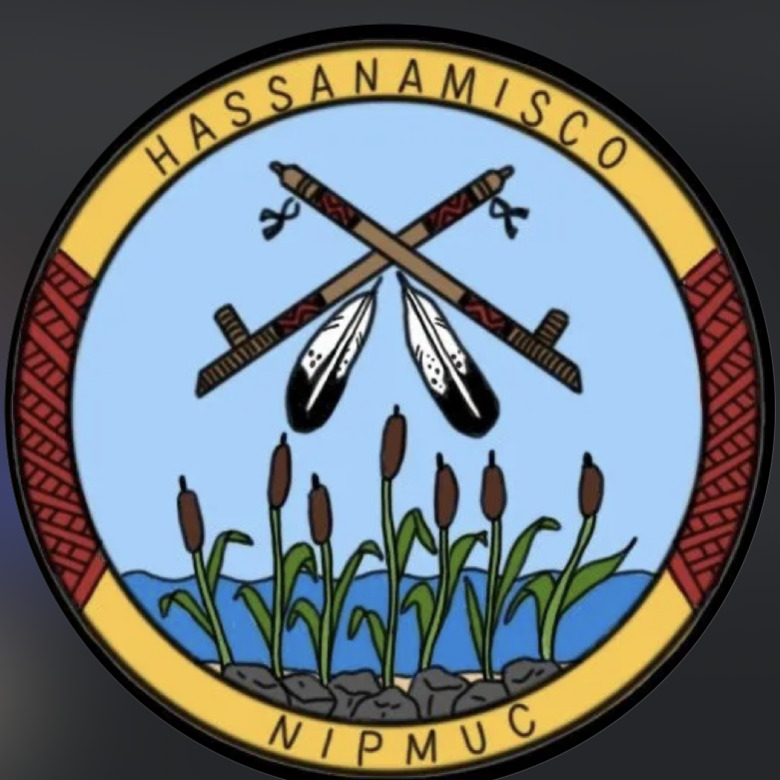
The splinter group uses a similar name and a similar visual identity to ours. If you see this logo, it is not associated with the Nipmuc Nation in any way. It represents a separate, fraudulent entity with no legitimate claim to speak for the Hassanamisco Tribe.
The Record
What Changed in the State's Own Paperwork
The Massachusetts Commission on Indian Affairs publishes an informational contact list of historic tribes. It is not a legal recognition document, and it cannot amend a Governor's Executive Order, but it's revealing to compare what it said in 2019 against what it says today.
2019 Edition
Listed as: Hassanamisco Nipmuc Tribe
Address line: c/o Nipmuc Nation Tribal Council
Contacts listed: Cheryll Holley, Chief, and Kenneth Gould, Sr., Chairman
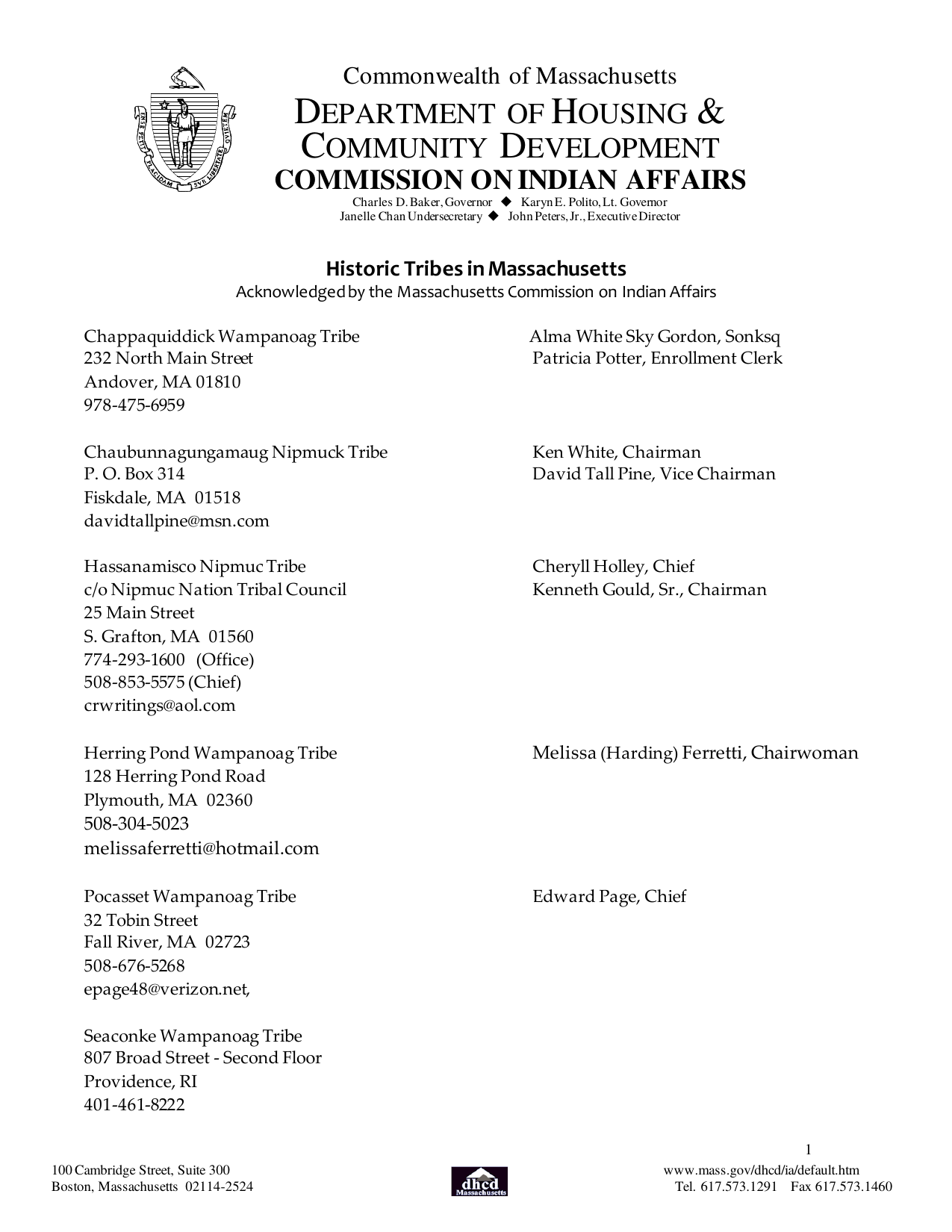
Exhibit: Commonwealth of Massachusetts, Dept. of Housing & Community Development, updated 11/20/2019
2026 Edition
Listed as: Hassanamisco Nipmuc Band (name changed)
Address line: c/o Nipmuc Nation Tribal Council (removed)
Contacts listed: Cheryll Holley, Sonksq/Chief. Kenneth Gould, Sr., Chairman (removed)
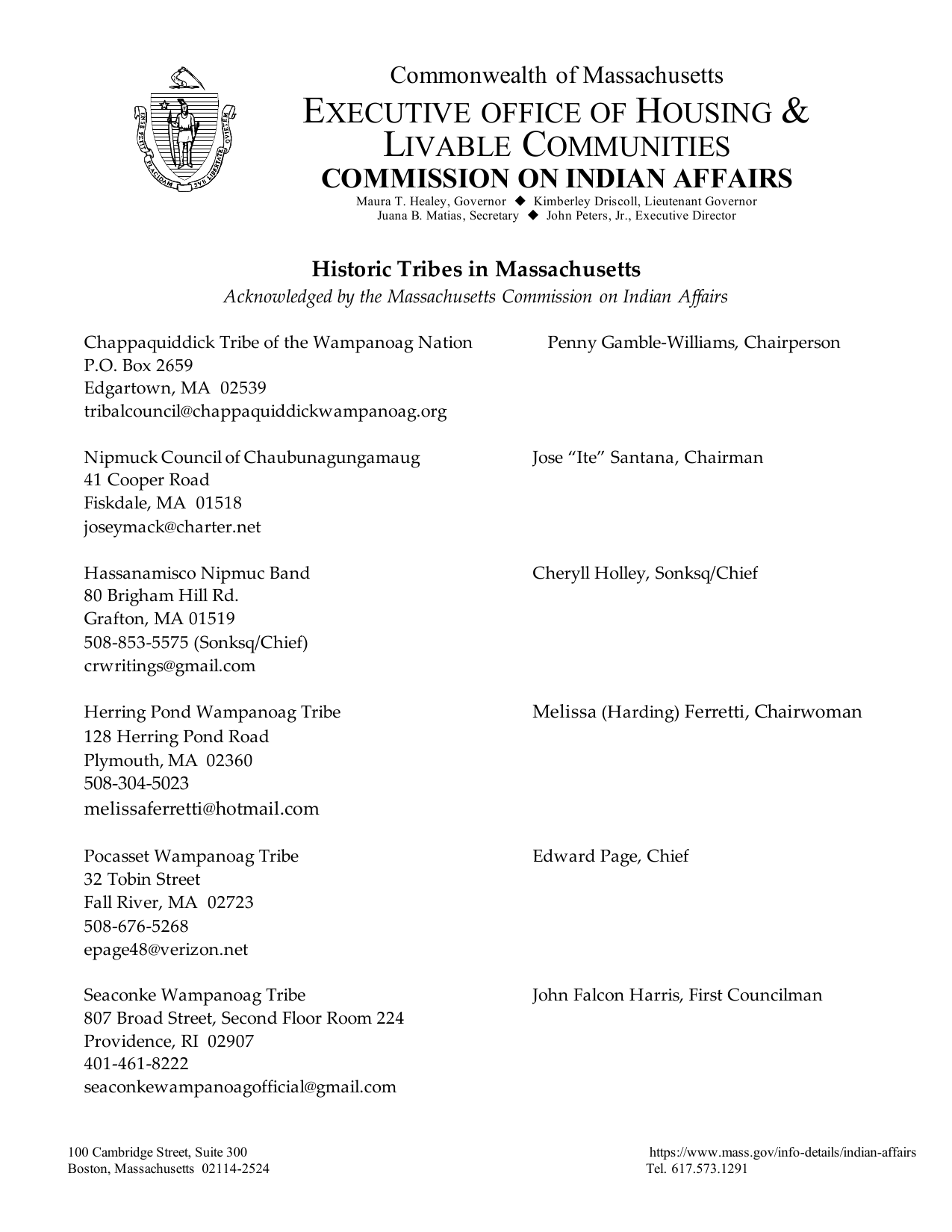
Exhibit: Commonwealth of Massachusetts, Executive Office of Housing & Livable Communities, updated 4/7/2026
Between those two editions, the Tribal Council's name disappeared from its own listing, the entry was quietly renamed from "Tribe" to "Band," and the second contact representing the Council was dropped entirely, leaving only the individual associated with the splinter faction. No public notice, hearing, or amendment to the 1976 Executive Order accompanied this change.
This is itself evidence of the Commission overstepping its authority. As shown above, M.G.L. c.6A §8A gives the Commission no power to determine, rename, or reassign a tribe's governing structure, only to investigate, assist, and recommend. Altering an official listing to strip out a sitting Tribal Council and replace it with a self-declared "Band" is not a clerical update. It is the Commission exercising a power it was never given, through the quiet mechanism of a contact sheet instead of the mechanism the law actually requires: legislative or executive action.
Correspondence
A Letter That Reaches Beyond the Commission's Jurisdiction
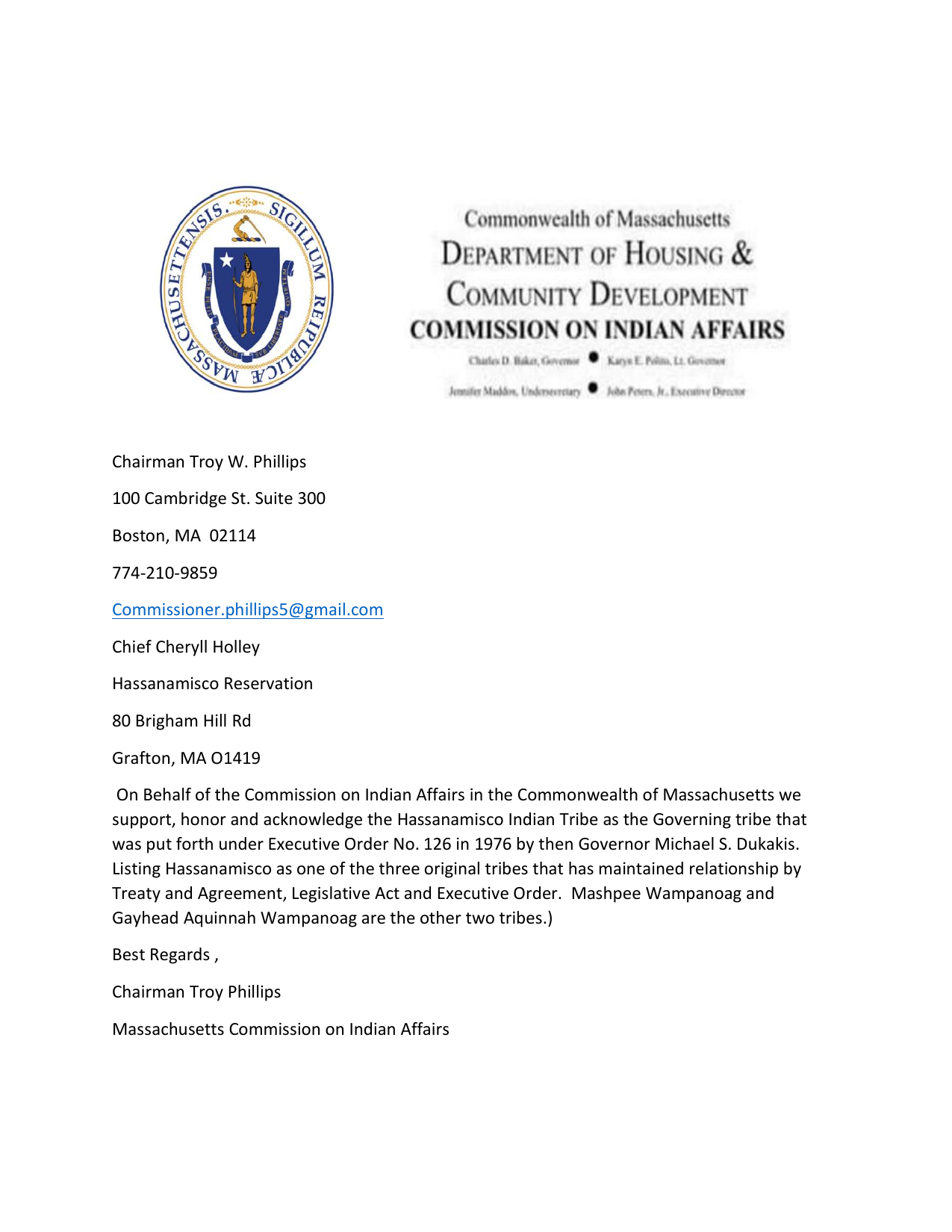
Troy W. Phillips, Chairman of the Massachusetts Commission on Indian Affairs, sent a letter to Cheryll Holley on Commission letterhead. In it, he states that the Commission "acknowledges the Hassanamisco Indian Tribe as the Governing tribe" under Executive Order No. 126.
The Commission's own governing statute, M.G.L. c.6A §8A, limits its role to investigation and assistance. It does not authorize the Commission, or any single Chairman acting on its behalf, to reinterpret or re-issue a sitting Governor's Executive Order through personal correspondence. A letter signed by one Chairman is not a Commission vote, a public hearing, or a rulemaking, and it cannot exercise a power the Commission was never granted in the first place. A letter that stretches outside the authority granted to its author deserves scrutiny, not automatic deference.
Phillips is documented as a member of the Hassanamisco Nipmuc Band Council, the governing body of the splinter group itself, and a signatory to its own letter declaring a break from the Nipmuc Nation Tribal Council. He wrote this Commission letter supporting that same band while holding a seat on its council, using his state office to lend official weight to an organization he personally helps lead.
On the Record
A Formal Ethics Complaint
On March 2, 2022, counsel for the Nipmuc Nation Tribal Council filed a formal complaint with the Massachusetts State Ethics Commission against Commissioner Troy Phillips. The complaint alleged violations of two specific statutes:
- G.L. c.268A §23(b)(3): appearance of a conflict of interest, for issuing an official Commission statement on a contested governance matter while sitting on the governing council of one of the parties to that dispute.
- G.L. c.268A §13: financial conflict of interest, for standing to personally benefit, directly or indirectly, from grants and donations that could flow to the band he helped establish and represent.
The complaint noted that around the same time, Holley published her own letter announcing the separation, stating in part that Nipmuc Nation is "hereby dissolved" and describing a new governing structure for the band, a letter Phillips signed as a listed member of its council.
Status: This complaint remains unresolved. The Ethics Commission has not issued a public finding either affirming or dismissing the allegations. We are publishing the complaint as filed, and its status as unresolved, without claiming a determination that has not been made.
A Simple Test
Can a Group Formed in 2022 Be a "Historic Tribe"?
In February 2022, a unilateral and unauthorized change in leadership created the split that produced the group now calling itself the "Hassanamisco Nipmuc Band." That's not a disputed date. It's a matter of recent record. Read our full account on the History page.
The Hassanamisco Nipmuc people, by contrast, have documented, continuous use of the Hassanamisco Reservation for at least 282 years, recognition under a Governor's Executive Order since 1976, and a Tribal Council structure that predates 2022 by decades. A faction that organized itself in 2022 cannot simultaneously be the "historic tribe" that a 1976 Executive Order was written to recognize. The timeline doesn't allow it. Ask any group claiming historic status a simple question: what did your governing body look like in 1976? In 2000? In 2020? If the honest answer is "it didn't exist yet," the claim answers itself.
Learn More
Read the Record for Yourself
Executive Order No. 126
The 1976 order naming the Tribal Council as the Commonwealth's point of contact.
Read it →Press Releases
NCAI's membership denial, the June 2025 court findings, and the July 2026 Land Court dismissal.
Read the releases →NCAI Directory
Verify the Nipmuc Nation's standing with the National Congress of American Indians.
Visit NCAI →Sources
References
View sources
- 25 CFR Part 83, "Procedures for Federal Acknowledgment of Indian Tribes," U.S. Department of the Interior, Bureau of Indian Affairs. ecfr.gov
- National Congress of American Indians. Tribal Directory and membership process. ncai.org
- Massachusetts General Laws, Chapter 6A, Section 8A, "Commission on Indian affairs; membership; functions." malegislature.gov
- Massachusetts Commission on Indian Affairs, "Historic Tribes in Massachusetts" contact list, updated 11/20/2019
- Massachusetts Commission on Indian Affairs, "Historic Tribes in Massachusetts" contact list, updated 4/7/2026
- Letter from Troy W. Phillips, Chairman, Massachusetts Commission on Indian Affairs, to Cheryll Holley
- Complaint to the Massachusetts State Ethics Commission, Enforcement Division, re: Troy Phillips, filed March 2, 2022 on behalf of the Nipmuc Nation Tribal Council (status: unresolved)
- Executive Order No. 126, Governor Michael S. Dukakis, July 8, 1976. See Government page